
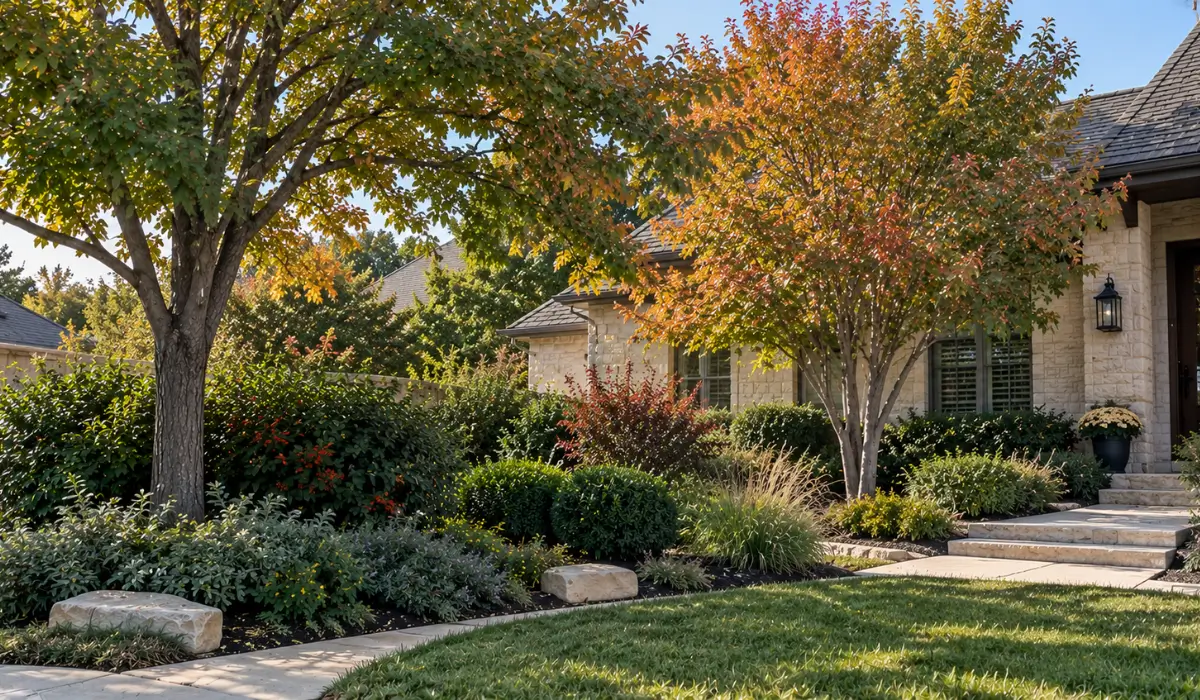
Effective fall landscape design in Austin combines trees and shrubs with berries, bark, grasses, and evergreen structure instead of relying on one colorful tree. Plant choices should also fit the property’s sun, soil, water, mature plant size, and maintenance needs.
Because fall color in Austin can vary each year, layered planting creates more dependable seasonal interest across the yard. All Seasons Austin Landscaping serves homeowners across the Austin area.
Before selecting individual plants, consider where seasonal color comes from and how those features can work together from fall into winter.
A landscape can gain fall color in Austin from five main sources: foliage color, berries and fruit, flowers, ornamental bark and branches, and an evergreen backdrop. Combining them keeps the yard interesting as conditions change.
Plant type, weather, sunlight, soil moisture, health, temperature, and stress can change leaf color. A design that also uses berries, texture, bark, and evergreens is less dependent on one tree producing the same display every year.
Berries can stand out against evergreen foliage, while grasses, seed heads, bark, and branch structure remain visible after leaves fall.
Fall color in Austin can come from changing leaves, berries, flowers, bark, grasses, and evergreen contrast. A layered design usually provides more reliable seasonal interest than one specimen tree alone.
Choose plants based on where the landscape is actually seen and used, not simply where there is an empty bed.
For front yard landscape ideas, consider house color, scale, entry framing, sightlines, utilities, sidewalks, and entryway color. A focal plant should strengthen the view without overwhelming the home as it matures.
Place seasonal features where important windows can benefit from them. Check mature growth so a plant adds to the view without unnecessarily blocking light.
Close-range planting makes roots, falling berries or leaves, staining, clearance, lighting, texture, and cleanup more important.
One well-placed specimen can give an open corner more structure than several unrelated plants competing for space and attention.
Trees create canopy, shrubs carry color closer to eye level, and smaller plants connect the design to beds and paths.

Before choosing a tree for color, consider mature height and spread, root space, utilities, nearby structures, future shade, leaf drop, watering, and pruning. The same long-term factors shape Austin shade tree considerations.
Cedar elm, Texas red oak, and red maple remain candidate trees rather than universal recommendations. Red maple deserves particular attention to cultivar and site conditions before selection.
| Tree | Fall Interest | Size | Site / Water | Best Design Role | Maintenance / When It May Not Fit |
|---|---|---|---|---|---|
| Cedar elm | Yellow fall foliage; reliable fall color | Large | Moderate water; tolerates drought, alkaline and poorly drained soils | Adaptable shade/canopy tree | Drooping branches may need pruning; aphids, powdery mildew and mistletoe can be concerns |
| Texas red oak | Brilliant red fall color; textured bark | Medium | Dry; tolerates drought and alkaline soil | Seasonal-color shade or specimen tree | Oak wilt is a serious disease concern |
| Red maple | Brilliant yellow-to-red fall color | Large | Moderate water; tolerates partial to heavy shade and poorly drained sites | Seasonal-color canopy or specimen tree | Not drought- or salt-tolerant; site selection matters |
Cedar elm adapts to varied conditions, while Texas red oak tolerates drought and alkaline soil. Red maple needs moderate water and is not drought-tolerant, so match the tree to the site rather than choosing on fall color alone.
Choose a tree that fits the property’s growing conditions, available space, maintenance needs, and year-round design—not fall color alone. As it matures, pruning, health, and clearance may also become part of Austin tree care services.
Shrubs can bring seasonal detail closer to windows, entries, paths, and other frequently viewed areas. Yaupon holly, possumhaw holly, flameleaf sumac, and American beautyberry are among the candidates to consider for shrubs for fall color, subject to the conditions of the planting site.
| Shrub | Seasonal Interest | Mature Size | Site Needs | Design Role | Placement / Maintenance |
|---|---|---|---|---|---|
| Yaupon holly | Evergreen foliage; persistent red berries |
Usually up to 25 ft. Varies by cultivar |
Sun to shade; low water | Hedge, screen or evergreen accent | Match cultivar to space; male and female plants needed for berries |
| Possumhaw holly | Yellow fall foliage; red-orange winter berries | 15–30 ft. tall | Sun to part shade; medium water | Accent, understory or winter interest | Allow room for mature size; female plants bear fruit |
| Flameleaf sumac | Vivid red-orange foliage; red fall fruit |
Usually up to 20 ft. Can reach 30 ft. |
Sun; low–medium water; dry, well-drained soil | Fall-color accent or naturalistic grouping | Can sucker and spread; give it room |
| American beautyberry | Purple fruit; yellow-green fall foliage |
3–6 ft. tall 4–6 ft. wide |
Part shade; low water; moist soil | Understory, screen or seasonal accent | Loose, arching habit; prevent complete soil dryness |
From Our Landscaping Team“We consider mature size, sunlight, water needs, growth habit, and where the plant will be viewed—not just how it looks at the nursery. That helps seasonal plantings fit the landscape as they mature.”
— All Seasons Austin Landscaping Team
Seasonal interest may come from foliage, berries, flowers, or texture, but decorative shrubs chosen at nursery size can eventually crowd windows, paths, neighboring plants, or other foundation planting.
Growth habit, drainage, available water, and maintenance should also narrow the choices before installation.

The right spacing becomes clearer when you compare young nursery plants with the space they may occupy over time.
Perennials, grasses, ground covers, containers, and low shrubs can reinforce the main palette without competing with larger plants. Their changing needs may also become part of Austin garden care services.
A defined palette creates a more coordinated autumn garden design.
Use repeated red, orange, copper, gold, and deep green rather than making every plant a different color.
Berries against evergreen foliage can keep contrast visible after leaf color fades.
Muted gold, burgundy, grasses, gray-green foliage, and bark let texture carry more of the design.
A dark evergreen background can frame one brighter tree or shrub. House and hardscape colors should help determine the palette.
Site conditions should narrow the plant list before color makes the final decision.
Prioritize controlled mature plant size, sightlines, fewer varieties, and year-round structure
Use appropriate canopy scale, repetition, layered beds, and irrigation coverage for plants viewed from farther away.
Put shade tolerance first. Berries, bark, texture, and lighter foliage can contribute where strong leaf color is less dependable.
Afternoon sun and reflected heat can increase stress. Heat tolerance and irrigation coverage should narrow the choices before color does.
Consider roots, cleanup, fragrance, shade, lighting, clearance, and nearby paving because these plants are experienced at close range.
| Season | Main Interest | Planning Question |
|---|---|---|
| Early fall | Flowers, berries, first foliage | What starts the display? |
| Mid-fall | Tree and shrub color | Where is peak color visible? |
| Late fall | Berries, grasses, bark | What remains after leaves fall? |
| Winter transition | Branches, evergreens | Does the yard still look intentional? |
A seasonal landscape design that staggers these features extends seasonal interest. Austin fall landscaping ideas connect planting decisions with irrigation, lawn conditions, and other seasonal needs.
Texas native plants can be valuable, but native, drought-tolerant, and low-maintenance are not the same. Mature size, soil, drainage, sun, irrigation, roots, and hardscape still determine whether a plant fits.
The City of Austin’s Grow Green landscaping resources address plant selection within local landscape conditions.
Our landscape design and installation services bring plant placement, spacing, site conditions, and installation into one plan.
When a preferred plant is unavailable, choose a substitute that performs the same role and fits the available space, water conditions, timing, and palette.
New trees and shrubs may need different establishment watering than a lawn. Irrigation coverage, soil drainage, and the developing root zone should be considered together rather than assuming an existing lawn schedule suits new woody plants.
Poor coverage can also make irrigation repair and maintenance part of the planting plan.
An Austin landscape designer should look beyond individual plant choices and consider how the entire property works together. A design consultation may include:
For homeowners planning landscape design Austin TX projects, reviewing these factors together can help connect seasonal color with practical needs such as spacing, irrigation, maintenance, and long-term appearance.
All Seasons Austin Landscaping can coordinate landscape design and installation services around the property’s conditions, the homeowner’s preferences, and the intended use of the outdoor space.
A strong fall landscape design should still look intentional after peak foliage fades. Plan beyond the brightest weeks of the season by focusing on four things:
This approach makes trees and shrubs part of a year-round composition rather than a short-lived October display.
What trees have the best fall color in Austin?
There is no universal winner. Cedar elm, Texas red oak, and red maple can be evaluated alongside the property’s sun, soil, water, mature space, and desired seasonal effect. Red maple needs additional attention to cultivar and site conditions.
Do red maples grow well in Austin?
Red maple should not be treated as a default choice for every Austin property. The specific cultivar and planting site’s sun, soil, water, available space, and other growing conditions should determine whether it belongs in the design.
What shrubs add fall color in Central Texas?
Shrub-based fall interest can come from foliage, berries, flowers, and texture. Yaupon holly, possumhaw holly, flameleaf sumac, and American beautyberry are candidates worth comparing, with the final choice based on mature space, sunlight, soil, water, maintenance, and the role the shrub needs to perform.
Is October a good time to plant trees and shrubs in Austin?
Fall can suit many installations, but weather, plant type, irrigation, and site readiness still matter. Planting timing should support successful establishment rather than follow the calendar alone.
How can I add fall color to a small front yard?
Use one focal plant, controlled mature sizes, a limited palette, evergreen structure, and repeated accents. Fewer coordinated plants can create a clearer seasonal effect without crowding a small space.
Are native Texas plants always low-maintenance?
No. Native status does not remove the need to consider placement, soil, drainage, establishment, irrigation, mature size, and ongoing maintenance. A native plant placed in unsuitable conditions can still perform poorly or create conflicts as it matures.
How do I make a fall landscape look good after the leaves drop?
Plan beyond foliage. Evergreen structure, berries, bark, grasses, branch form, hardscape, and landscape lighting can maintain shape, texture, and contrast after deciduous leaves fall.
A coordinated planting plan makes sense when several trees and shrubs must work together for fall color, mature spacing, water needs, and year-round structure. All Seasons Austin Landscaping can help connect those choices through Austin landscape design and related planting needs.
To turn your plant ideas into a plan for your property, schedule a fall landscape consultation with our team.