
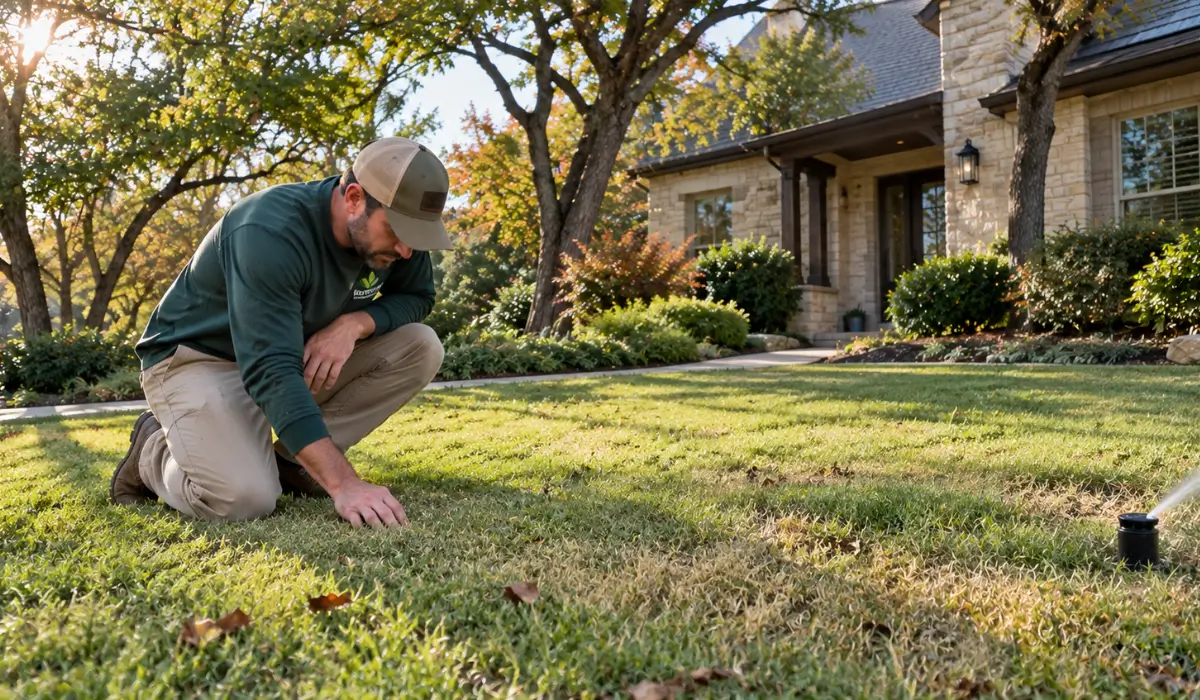
Fall lawn care in Austin should focus on what your lawn needs before winter: appropriate mowing, irrigation adjustments, leaf management, weed planning, and soil or turf correction when needed. To prep your lawn for a healthier spring, start with its current condition rather than assuming it needs fertilizer, aeration, or overseeding.
Summer can leave useful clues. Dry corners may point to sprinkler coverage, while thin grass or bare spots may trace back to shade, traffic, or other stress. We work backward from the spring result you want, using grass type, growth stage, and current lawn conditions to guide fall decisions. Start with the spring problem you want to prevent, then determine what deserves attention now.
| Spring Problem | What May Need Attention in Fall |
|---|---|
| Heavy weeds | Identification, timing, bare soil |
| Thin turf | Shade, traffic, irrigation, grass type |
| Uneven green-up | Water coverage, soil, grade, turf dormancy |
| Soggy or dry areas | Irrigation, soil compaction, drainage |
| Weak growth | Soil, turf health, treatment timing |
The best fall lawn-care task depends on the spring problem you want to prevent. Weed pressure, thin turf, poor drainage, uneven watering, and weak growth require different fall plans.
A thin edge may also be dry because sprinkler coverage misses it. Diagnose the likely cause before choosing a treatment.
Grass type affects growth, dormancy, mowing, watering, fertilizer timing, herbicide suitability, overseeding, and spring expectations. Start by identifying the type of Texas turfgrass in the lawn before selecting a treatment or assuming an October task is appropriate.
Fading color and slower growth can occur as warm-season turf approaches dormancy. That seasonal change should be distinguished from irrigation problems, disease, pests, soil issues, or other stress before treatment is recommended.
Multiple turf varieties, winter overseeding, weedy grasses, shade damage, or new sod beside older grass can require different decisions across one yard. Warm-season lawn care starts with knowing what is actually growing.
Mark areas that browned first, stayed wet, received heavy traffic, lost sunlight, missed sprinkler coverage, developed weeds, or formed bare spots.
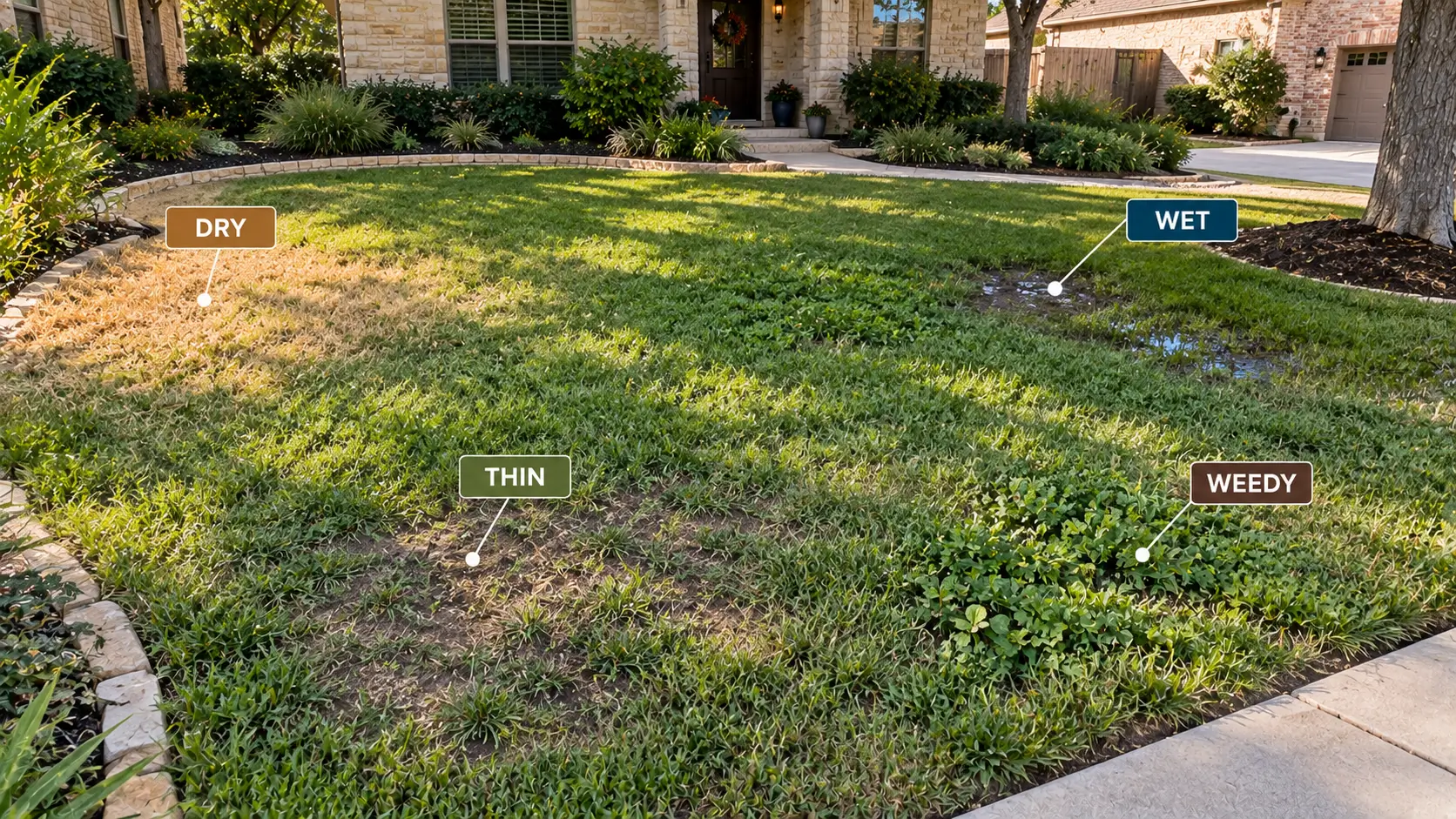
Label recurring problem areas as dry, wet, thin, or weedy, and note where conditions overlap. A thin area may also be dry, while a persistently wet section may develop different turf or weed problems. These overlaps can help separate an underlying site problem from a symptom that needs treatment.
Water collecting near beds, washing soil downhill, or repeatedly leaving one area dry can point to conditions beyond the turf itself. Problems with grading, drainage, or surrounding planting areas may need to be addressed as part of the solution. In those cases, landscape design and installation can help correct site conditions that continue to affect the lawn.
At All Seasons, we don’t assume thin, brown, or weedy turf needs fertilizer, seed, or another treatment. We look at the grass type, irrigation coverage, drainage, soil conditions, shade, traffic, and the pattern of damage first. A dry strip may point to uneven sprinkler coverage, for example, while recurring thin turf in the same area may indicate a site condition that needs to be addressed before the grass can recover.
From Our Landscaping Team“We look at what the lawn is showing us before deciding what treatment belongs in the plan. A dry area, thin turf, weeds, or changing color can have different causes, so identifying the grass and checking irrigation and site conditions comes before automatically adding fertilizer, seed, or another treatment.”
— All Seasons Austin Landscaping
Mow while turf is growing. Avoid scalping, removing too much leaf material, mowing saturated soil, dull blades, and heavy clippings. The right mowing height depends on the turf.
Light leaves may be mulched when appropriate. Heavy buildup should be removed so it does not cover turf or block drains and sprinkler heads. Timely leaf removal also makes developing problems easier to see.
Edging can expose runoff, erosion, overspray, encroachment, or low areas. Our lawn maintenance services can keep routine mowing and edging aligned with changing lawn conditions.
Run each irrigation zone before changing the schedule. Look for broken or tilted heads, clogged nozzles, dry corners, excessive overlap, leaks, runoff, pressure differences, and grass blocking the spray.
An irrigation inspection should check tilted or broken heads, clogged nozzles, dry corners, leaks, runoff, pressure differences, overlap, and blocked spray.
Cooler weather, shorter days, rainfall, soil moisture, turf growth, and overseeding can change irrigation needs. Inspect the lawn and irrigation system before adjusting the schedule rather than automatically continuing summer watering.
Watering rules can also affect when irrigation is permitted, so check the current City of Austin watering schedule before changing irrigation days or times.
If one area stays dry while nearby turf receives enough water, inspect that zone before increasing whole-yard watering. Irrigation system repair and maintenance can address leaks, broken heads, and uneven coverage.
Before fall fertilizing, consider the turf type, growth stage, lawn condition, soil information, recent applications, irrigation, weather, and product directions. Losing summer color alone does not establish that the lawn needs fertilizer.
Before fall fertilizing, consider the turf type, growth stage, lawn condition, soil information, recent applications, irrigation, weather, and product directions. Losing summer color alone does not establish that the lawn needs fertilizer.
Seasonal slowing, watering, shade, soil conditions, pests, disease, mowing stress, and previous treatments can all affect turf color. Diagnose the likely cause before treating discoloration as a nutrient problem.
The same diagnosis-first principle applies during hotter months, when summer lawn fertilization in Austin also needs to account for heat, turf condition, irrigation, and treatment timing.
Fertilizer timing should support the turf’s actual growth and condition rather than simply encourage additional color before dormancy. Any application should follow the fertilizer label and current turf-specific guidance.
Determine whether weeds are annual or perennial, grassy or broadleaf, existing or yet to emerge, and isolated or widespread.
Pre-emergent products are intended to control certain weeds before they emerge. Post-emergent products are intended for certain weeds that are already present. Neither category is appropriate for every weed, turf type, or situation.
Weed identification comes first. Treatment selection can depend on the weed, turf type, soil and weather conditions, irrigation, overseeding plans, and other lawn treatments.
Pesticide use must follow the product label, including approved sites, target weeds, application directions, restrictions, and precautions.
Do not assume a treatment is compatible with the lawn or an overseeding plan simply because it is marketed for weed control.
Fall weed control should also address why weeds have room to return. Thin turf, pet damage, shade, erosion, irrigation gaps, disturbance, or compaction can keep an area vulnerable.
Overseeding can provide seasonal coverage, but it is not automatically a repair for the permanent warm-season lawn underneath it. Existing turf, the homeowner’s appearance goals, irrigation, mowing, maintenance, planned weed treatments, and spring transition should all be considered before overseeding.
A worn route may indicate soil compaction, a dry strip may point to irrigation, and a low area may need leveling. Correct the cause before replacement. The same principle applies when installing new sod in Austin.
Brown or slow-growing turf is not automatically dead. A dormant lawn can still have healthy roots.
Soil testing can provide useful information about characteristics such as nutrient status and pH when those factors are relevant to the lawn problem. Sampling needs to be representative of the area being evaluated so the results can support better decisions rather than add another assumption.
Aeration should respond to an identified need rather than the month on the calendar. Grass type, active growth, compaction, soil moisture, planned overseeding, and the purpose of aeration should be considered before scheduling the work.
Hard soil, runoff, shallow roots, traffic thinning, construction disturbance, and low spots can point to different problems. Good soil preparation separates compaction from uneven ground, which may instead call for lawn leveling services.
| Desired Spring Result | Fall Action | Winter Monitoring | Spring Follow-Up |
|---|---|---|---|
| Fewer weeds | Identify and plan | Watch patterns | Reassess control |
| More even turf | Correct water/traffic | Note wet/dry areas | Repair sections |
| Better soil response | Assess soil/compaction | Limit disturbance | Time needed work |
| Cleaner appearance | Mow/manage leaves | Remove buildup | Resume maintenance |
| Improved coverage | Compare options | Protect areas | Check establishment |
Use fall to prepare your lawn for spring by addressing the cause before the repair where possible.
The best way to prep your lawn for spring is to correct problems that actually need attention rather than adding treatments by default.
Our team uses a lawn assessment to sort through those conditions before recommending treatment. Lawn maintenance can coordinate mowing, fertilization, overseeding, leveling, and irrigation when several seasonal needs overlap.
All Seasons Austin Landscaping is a family-owned and operated Austin-area business providing lawn and landscaping services. Homeowners can also check the Austin areas we serve when determining local service availability.
A fall treatment makes sense when the lawn’s condition gives you a clear reason for it. When the cause is unclear or several problems overlap, the practical next step is to sort out what needs attention before adding another treatment.
Our team can discuss the lawn, your spring goal, and the services that may fit. Tell us what you are seeing.
Request a Free Estimate & Consultation