
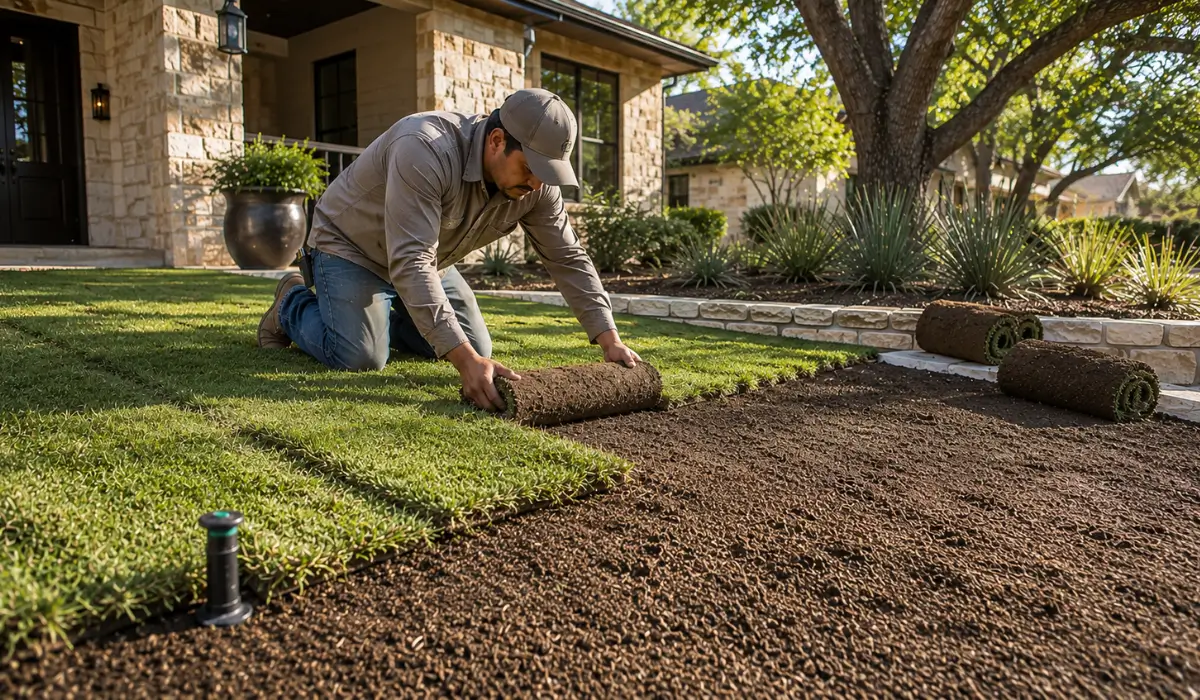
September can be a practical time for sod installation in Austin because lawns may face less intense heat while the soil can remain suitable for root development. Timing alone, however, does not guarantee successful establishment.
Before installing new sod, homeowners should understand why the old lawn struggled, check the grade and irrigation coverage, choose turf suited to the site, and make sure early care is manageable.
Laying sod and establishing it are different stages. Installation puts the turf in place, while establishment happens as roots connect with prepared soil. All Seasons Austin Landscaping works with lawn and irrigation needs, and our Austin landscaping services consider the conditions around the turf before installation.
September can support sod installation in Austin, but the lawn must be prepared first. New sod cannot correct poor grading, compacted soil, irrigation gaps, or drainage problems on its own.
Successful sod installation in Austin depends on appropriate turf selection, soil contact, surface preparation, irrigation coverage, drainage, installation quality, early watering, reduced traffic, and weather.
Texas A&M AgriLife’s turfgrass management resources support considering grass selection, irrigation, mowing, and site conditions as connected parts of turf care.
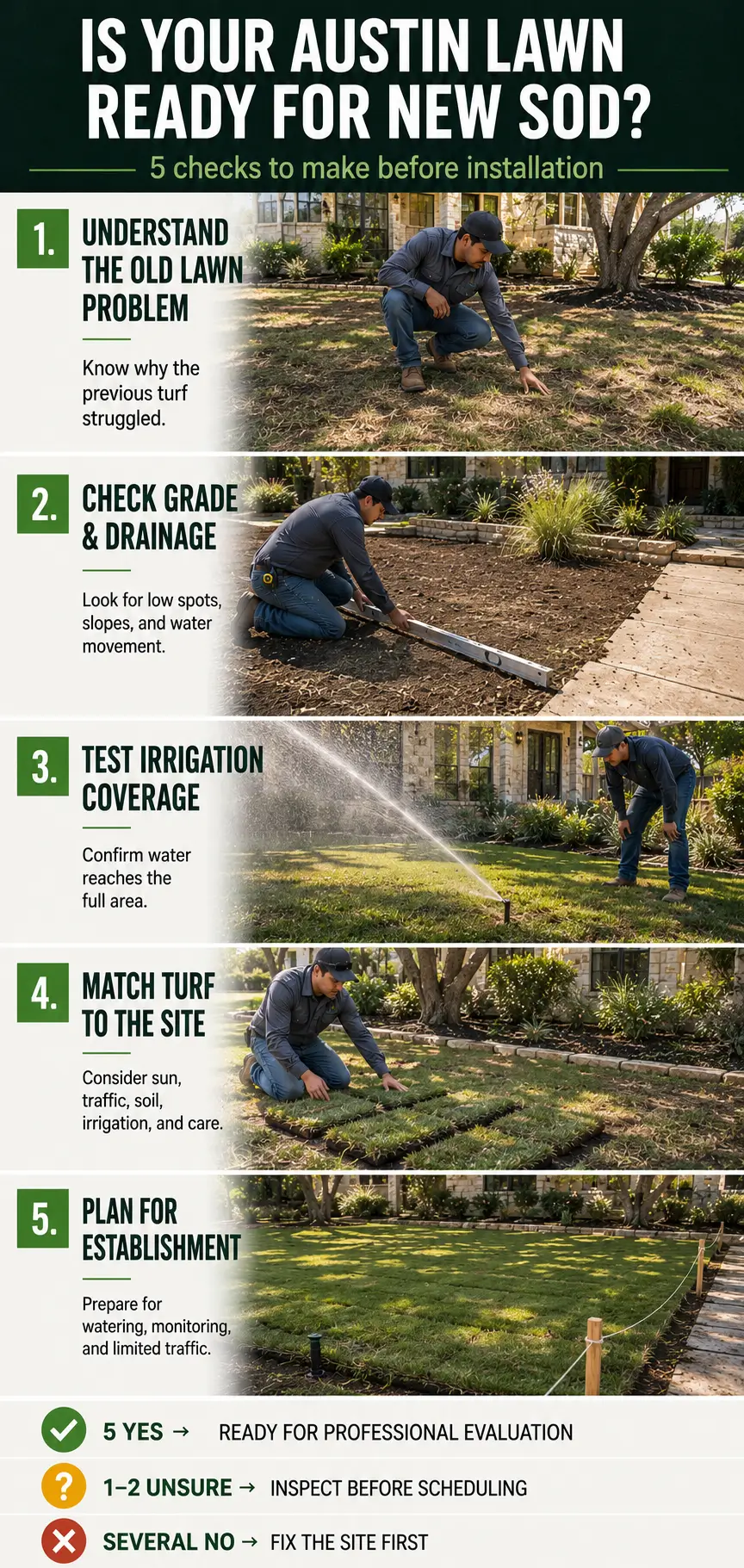
Before homeowners order new sod in Austin, use these five checks to find conditions that could interfere with establishment while the lawn and soil are still exposed.
Determine whether drought, shade, low spots, uneven irrigation, construction damage, pests, or disease contributed to the old lawn’s decline. Different causes require different corrections.
Grass thinning under heavy shade is different from a corner repeatedly missed by sprinklers. Our summer lawn care tips cover seasonal stresses that can affect Austin lawns.
New sod should not be expected to succeed under the same unresolved conditions that caused the previous lawn to fail.
Look for low spots, abrupt slopes, deep ruts, soil washing toward hardscape, water collecting near structures, and uneven transitions beside sidewalks or patios. These conditions can affect soil contact and water movement.
For uneven surfaces, lawn leveling services can address low areas and other conditions that should be evaluated before turf covers the ground.
The goal is not a perfectly flat yard. The surface should support consistent soil contact while maintaining necessary drainage. The City of Austin’s local flooding information reinforces the importance of considering how water moves across a property.
Test every sprinkler zone, including edges, corners, narrow strips, slopes, and areas beside hardscape. Check pressure, spray obstructions, runoff, standing water, and missed watering zones.
Runtime and coverage are not the same thing. Running a zone longer will not correct a sprinkler head that never reaches a dry area.
Damaged heads, blocked spray, or uneven coverage should be corrected before installation. Our sprinkler repair and maintenance services can address problems that could leave new turf without adequate coverage.
Leaks, pressure problems, or broader system issues may require irrigation system repair and maintenance while the lawn is still exposed.
Turf selection should consider sun, shade, traffic, maintenance expectations, irrigation capacity, soil conditions, appearance, and nearby turf.
Different warm-season grass choices have different needs. There is no universal best grass for every Austin property, so turf should fit the site’s growing conditions and realistic maintenance level.
Homeowners should be able to follow site-specific watering instructions, limit foot and pet traffic, monitor seams and edges, delay mowing until appropriate, and respond to dry or lifted areas.
Rainfall and weather may require adjustments. Five yes answers suggest the yard is ready for professional evaluation; one or two uncertain answers should be inspected first, while several no answers mean site problems should be corrected before scheduling.
A successful Austin lawn installation begins before fresh turf reaches the property. Removal, surface correction, soil preparation, and irrigation testing create the conditions the sod will depend on.
Remove dead turf, weeds, debris, construction material, and buried obstacles where they interfere with preparation. Clean edges as needed so new turf can meet sidewalks, patios, and planting areas properly.
Correct low spots, ruts, uneven transitions, and other surface problems through grading, leveling, or smoothing where appropriate. The goal is an even installation surface that preserves necessary drainage.
Soil preparation for sod may include loosening compacted areas where appropriate, removing debris, evaluating soil condition, and creating an even surface.
The prepared area should provide close soil contact without excessive loose material that could settle unevenly.
Test irrigation while the ground is exposed so broken heads, weak pressure, blocked spray, and missed areas can be identified before sod arrives.
Sod is living material and should be placed without unnecessary delay. Temperature, turf condition, transportation, weather, and supplier instructions can affect handling, so a universal hour limit is not appropriate.
Sod seams should fit closely, with staggered joints where appropriate and without unnecessary overlaps or large gaps. Curves, borders, and hardscape edges also require careful fitting.
Lifted edges, air pockets, and uneven surfaces can interfere with sod root establishment. Good grading, site preparation, and careful placement help roots maintain consistent contact with prepared soil.
Watering new sod depends on turf type, soil, weather, slope, irrigation performance, rainfall, and local requirements. Early watering should follow site-specific instructions rather than one schedule for every lawn.
The first month should be treated as a progression rather than a fixed calendar schedule. Moisture, rooting, surface stability, weather, and turf condition help determine when care should change.
| Period | Main Focus | Watch For |
|---|---|---|
| Days 1–3 | Prevent excessive drying | Edges, seams, runoff |
| Days 4–10 | Compare moisture | Dry corners, muddy areas |
| Days 11–20 | Monitor rooting | Attachment, weak zones |
| Days 21–30 | Approach normal care | Mowing, traffic, watering |
Watch edges, seams, sunny areas, and slopes. Check irrigation coverage, limit foot traffic, monitor runoff, and account for rainfall without allowing prolonged saturation.
Look for dry corners, curling edges, muddy spots, standing water, opening seams, and missed irrigation. A localized problem does not mean the entire lawn needs the same watering adjustment.
Rooting varies with turf, soil, weather, moisture, and installation conditions. A gentle inspection can check attachment without repeatedly lifting broad sections and disturbing developing roots.
Adjust watering according to conditions, consider the first mow when the turf is ready, limit unnecessary traffic, and monitor weak areas.
As turf establishes, care can transition toward normal Austin lawn care. Our article on signs a lawn needs aeration covers compaction concerns that may matter later.
New sod should be mowed after it has begun rooting and the soil is firm enough to support the mower without shifting or rutting the surface. Calendar days alone should not determine the first mow.
The turf should show early rooting, the surface should be firm, and the soil should not be saturated. Use sharp mower blades and avoid removing too much leaf growth at once.
Texas A&M AgriLife’s turfgrass mowing recommendations show that mowing height depends on turf type, supporting a lawn-specific decision.
Not every struggling lawn needs complete replacement. The amount of viable turf, cause of decline, and condition of the surface should help guide the choice.
| Option | Best Suited For | Main Limitation | Preparation Need |
|---|---|---|---|
| New sod | Broad replacement | Requires careful preparation and early care | High |
| Overseeding | Supplemental coverage | Does not correct grading or soil problems | Moderate |
| Recovery plan | Existing viable turf | Improvement may be gradual | Depends on cause |
| Lawn leveling first | Uneven or low areas | Does not replace unhealthy turf | Site-specific |
Overseeding may provide supplemental or seasonal coverage where appropriate, but it does not correct drainage, soil, grading, or irrigation problems. Lawn leveling addresses surface conditions, while viable turf may instead benefit from a lawn maintenance recovery plan.
When replacement is part of a wider property project, landscape design and installation can help coordinate the lawn with surrounding features.
Shade, drainage, compaction, irrigation gaps, traffic, or unsuitable turf can continue affecting the replacement lawn. Fresh turf changes the surface but does not automatically correct those conditions.
Edges and sod seams can dry differently from the center of the lawn, especially near warm hardscape. Monitor these locations instead of assuming moisture is uniform everywhere.
Too little moisture can dry turf before roots establish, while too much can leave soil saturated and soft. A dry corner and a wet low spot require different corrections.
Kids, pets, deliveries, and equipment can shift turf or create ruts before the surface becomes stable. Access should increase as rooting and surface stability improve.
A mower can shift turf or rut soft soil when rooting is limited. Turf condition and surface stability should determine the first mow rather than a preset date.
Weak growth does not automatically mean new turf needs fertilizer. Moisture, rooting, soil conditions, and heat can also affect appearance.
Our Austin summer fertilization advice covers why lawn condition should guide fertilizer decisions.
The best way to protect a sod-installation budget is to correct the site before installation. Replacing failed sod costs more than preparing the soil, grade, and irrigation correctly the first time.
Measure accurately, correct necessary grading, repair irrigation, match turf to the site, reduce material waste, remove weeds and debris, and schedule installation when early care is manageable.
Protecting fresh turf from traffic also reduces avoidable damage. The goal is to prevent rework rather than cut preparation that affects establishment.
A professional evaluation should review why the old lawn struggled, sun and shade, soil condition, drainage, grade, leveling needs, irrigation coverage, turf selection, measurements, access, watering needs, and post-installation maintenance.
The All Seasons Austin Landscaping team brings landscaping experience to that evaluation so lawn, surface, and irrigation conditions can be considered together.
A useful assessment should leave homeowners understanding what the yard needs before turf is ordered. Austin service area details identify where All Seasons works.
Is September a Good Month to Install Sod in Austin?
September can be practical when heat is less intense and soil remains suitable for rooting. Turf type, preparation, irrigation, and weather still matter.
How Often Should New Sod Be Watered?
There is no universal frequency. Turf type, soil, weather, slope, rainfall, irrigation coverage, and local requirements should determine the plan.
Can Sod Be Installed Over an Existing Lawn?
New sod needs contact with a prepared surface. Existing turf, weeds, debris, and unresolved surface problems can interfere with establishment.
How Long Should People and Pets Stay Off New Sod?
Limit traffic while turf is rooting and the surface can still shift or rut. Rooting and surface stability are better indicators than a fixed number of days.
When Can New Sod Be Mowed?
Mow after rooting has begun, the surface is firm enough for equipment, and the grass has reached an appropriate height.
Does the Lawn Need to Be Leveled Before Sod Installation?
Low spots, ruts, and uneven transitions may need correction before installation while preserving necessary drainage.
Is Sod Better Than Overseeding?
Neither is universally better. Sod suits broad replacement, while overseeding may supplement existing turf where conditions are appropriate.
Can New Sod Fix Drainage Problems?
No. Sod cannot correct poor grading, runoff, compacted soil, or existing drainage problems.
September can provide a useful opportunity for installing new sod, but preparation determines whether the property is ready. The old lawn problem should be understood, irrigation tested, and the surface prepared for rooting and drainage.
Early care continues after installation before normal mowing, traffic, and routine Austin lawn care resume. Homeowners can review customer landscaping experiences when considering All Seasons Austin Landscaping.
All Seasons provides lawn maintenance, lawn leveling, irrigation repair, and related landscaping services for Austin-area properties. To check the yard before turf is ordered, request a sod-readiness assessment or call (512) 442-9603.